 Add to Chrome
 Add to Firefox
 Add to Edge
Revisiting ML Training under Fully Homomorphic Encryption: Convergence Guarantees, Differential Privacy, and Efficient Algorithms
May 27, 2026
We present the first theoretical convergence analysis of machine learning training under fully homomorphic encryption (FHE), combined with a differentially private (DP) training algorithm tailored to encrypted computation. Our approach improves computational efficiency over standard differentially private gradient descent (DP-GD) while achieving comparable utility. In particular, we prove convergence of approximate gradient descent using polynomial approximations of activation and loss functions, which are required for FHE compatibility. To preserve privacy in downstream tasks, we integrate differential privacy without relying on costly per-sample gradient clipping, enabling scalable encrypted learning. We also provide data-independent hyperparameter selection and theoretically grounded strategies for polynomial approximation which can be of independent interest. Together, these contributions advance the feasibility of efficient, private, and secure machine learning on sensitive data.

Trajectory-Consistent Calibration for Cache-Accelerated Diffusion Models
May 24, 2026Diffusion Transformers require repeated denoiser evaluations during iterative sampling, making inference computationally expensive. Cache-based acceleration reduces this cost by reusing intermediate representations across denoising steps, but can introduce representation deviations and degrade generation quality. In this paper, we analyze these deviations and show that effective calibration should consider both the direct mismatch caused by reuse and the subsequent trajectory shift induced by earlier corrections. To address this challenge, we propose Trajectory-Consistent Calibration (TCC), a training-free method that calibrates cached representations toward their full-computation counterparts. Specifically, rather than estimating all calibration priors from a single uncorrected cache trajectory, TCC uses an offline iterative procedure so that each prior accounts for the trajectory shift induced by preceding calibrations. Experiments on PixArt-alpha and DiT-XL/2 show that TCC consistently improves FID across representative cache-based acceleration methods while preserving their underlying reuse policies. Notably, in a representative PixArt-alpha cache-acceleration setting based on FORA, TCC reduces FID from 29.83 to 27.35, slightly surpassing the full-computation baseline.
Lumos: Efficient Performance Modeling and Estimation for Large-scale LLM Training
Apr 12, 2025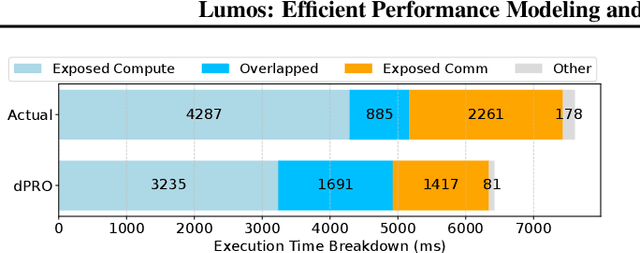
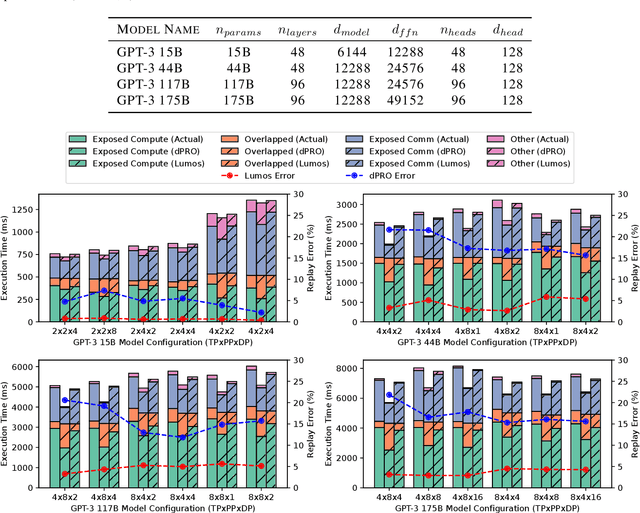

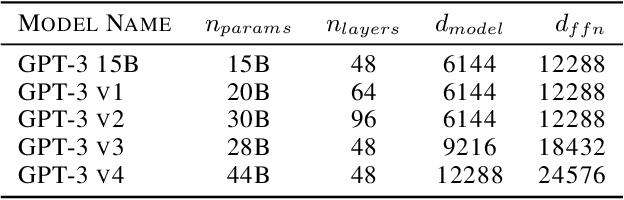
Training LLMs in distributed environments presents significant challenges due to the complexity of model execution, deployment systems, and the vast space of configurable strategies. Although various optimization techniques exist, achieving high efficiency in practice remains difficult. Accurate performance models that effectively characterize and predict a model's behavior are essential for guiding optimization efforts and system-level studies. We propose Lumos, a trace-driven performance modeling and estimation toolkit for large-scale LLM training, designed to accurately capture and predict the execution behaviors of modern LLMs. We evaluate Lumos on a production ML cluster with up to 512 NVIDIA H100 GPUs using various GPT-3 variants, demonstrating that it can replay execution time with an average error of just 3.3%, along with other runtime details, across different models and configurations. Additionally, we validate its ability to estimate performance for new setups from existing traces, facilitating efficient exploration of model and deployment configurations.
CALF: Benchmarking Evaluation of LFQA Using Chinese Examinations
Oct 02, 2024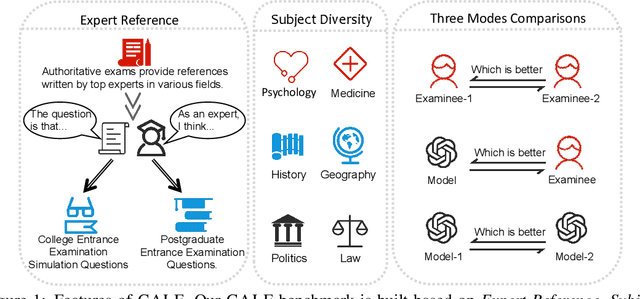
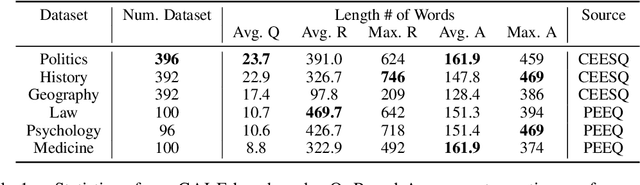
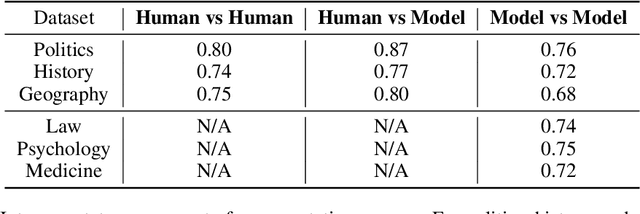
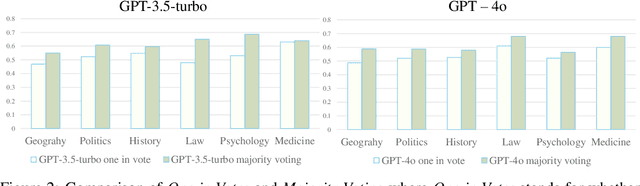
Long-Form Question Answering (LFQA) refers to generating in-depth, paragraph-level responses to open-ended questions. Although lots of LFQA methods are developed, evaluating LFQA effectively and efficiently remains challenging due to its high complexity and cost. Therefore, there is no standard benchmark for LFQA evaluation till now. To address this gap, we make the first attempt by proposing a well-constructed, reference-based benchmark named Chinese exAmination for LFQA Evaluation (CALF), aiming to rigorously assess the performance of automatic evaluation metrics for LFQA. The CALF benchmark is derived from Chinese examination questions that have been translated into English. It includes up to 1476 examples consisting of knowledge-intensive and nuanced responses. Our evaluation comprises three different settings to ana lyze the behavior of automatic metrics comprehensively. We conducted extensive experiments on 7 traditional evaluation metrics, 3 prompt-based metrics, and 3 trained evaluation metrics, and tested on agent systems for the LFQA evaluation. The results reveal that none of the current automatic evaluation metrics shows comparable performances with humans, indicating that they cannot capture dense information contained in long-form responses well. In addition, we provide a detailed analysis of the reasons why automatic evaluation metrics fail when evaluating LFQA, offering valuable insights to advance LFQA evaluation systems. Dataset and associated codes can be accessed at our GitHub repository.
Bounding the Excess Risk for Linear Models Trained on Marginal-Preserving, Differentially-Private, Synthetic Data
Feb 06, 2024The growing use of machine learning (ML) has raised concerns that an ML model may reveal private information about an individual who has contributed to the training dataset. To prevent leakage of sensitive data, we consider using differentially-private (DP), synthetic training data instead of real training data to train an ML model. A key desirable property of synthetic data is its ability to preserve the low-order marginals of the original distribution. Our main contribution comprises novel upper and lower bounds on the excess empirical risk of linear models trained on such synthetic data, for continuous and Lipschitz loss functions. We perform extensive experimentation alongside our theoretical results.
Mystique: Accurate and Scalable Production AI Benchmarks Generation
Dec 16, 2022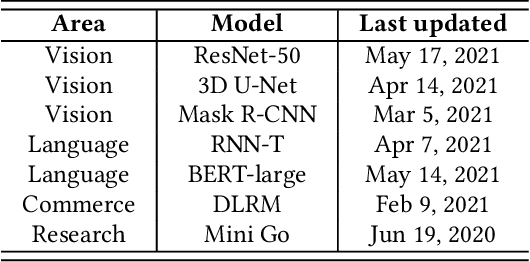
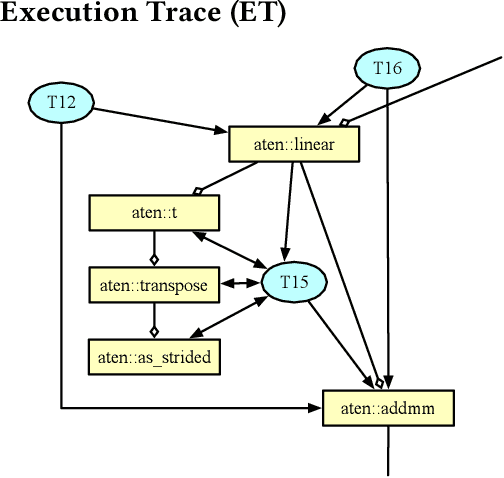
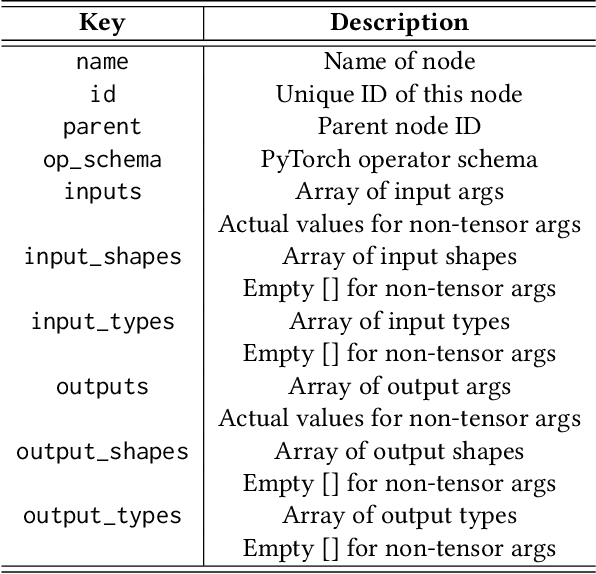
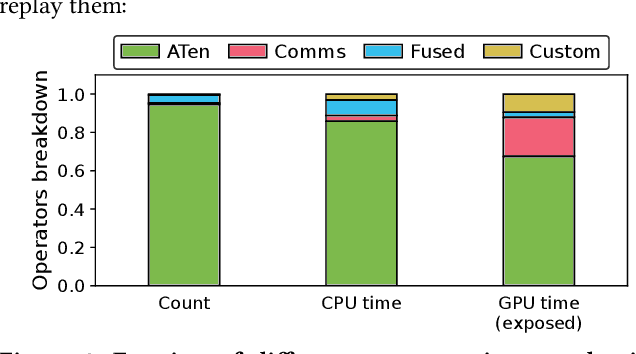
Building and maintaining large AI fleets to efficiently support the fast-growing DL workloads is an active research topic for modern cloud infrastructure providers. Generating accurate benchmarks plays an essential role in the design and evaluation of rapidly evoloving software and hardware solutions in this area. Two fundamental challenges to make this process scalable are (i) workload representativeness and (ii) the ability to quickly incorporate changes to the fleet into the benchmarks. To overcome these issues, we propose Mystique, an accurate and scalable framework for production AI benchmark generation. It leverages the PyTorch execution graph (EG), a new feature that captures the runtime information of AI models at the granularity of operators, in a graph format, together with their metadata. By sourcing EG traces from the fleet, we can build AI benchmarks that are portable and representative. Mystique is scalable, with its lightweight data collection, in terms of runtime overhead and user instrumentation efforts. It is also adaptive, as the expressiveness and composability of EG format allows flexible user control over benchmark creation. We evaluate our methodology on several production AI workloads, and show that benchmarks generated with Mystique closely resemble original AI models, both in execution time and system-level metrics. We also showcase the portability of the generated benchmarks across platforms, and demonstrate several use cases enabled by the fine-grained composability of the execution graph.